


A sense of nervous excitement. Visible is the chilled vapour emanating from my rivals as they do the "pre-race" jiggle on the starting line.
A swift flick of the hips.
I'm participating in my local 5km community parkrun and I'm serious. It's almost time...
Hold on. I need to start my watch. So does the runner alongside me.
The person in the line sighs. I'm not moving until… done! Signal acquired, and I'm running.
Amidst the crowd, it's difficult to find a person without a fitness tracker on it. And this isn't only us athletes who use them.
We're witnessing a thriving, massive industry. Brands like Samsung Galaxy are prevalent, each with an extensive range of various devices to fit a range of budgets. According to how feature-packed the model you select, prices can start from a hundred pounds to a significant investment.
"I find it infuriating, it's impossible to switch off."
"It reassures me… It acts as a companion encouraging me."
"I wish it wouldn't say about a bad night's sleep."
Just some of the responses I've had from other device users when I question what they their opinion is on theirs.
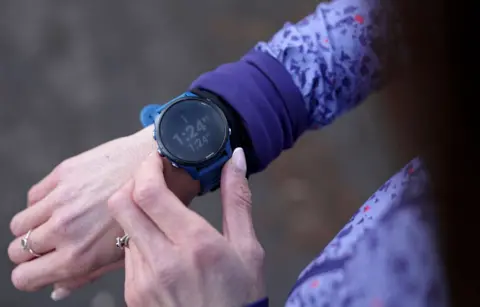
The Monitoring Conundrum
My feelings on my own device? Currently, irritating. It's telling me I'm off pace, leading me to doubt whether the foliage along my route are blocking my GPS connection.
Countless individuals of us attach these small monitors onto our wrists and use them 24/7, seemingly comfortable with the fact they're constantly monitoring us.
Gone are the days when we depended on them only to give us an idea of our daily steps. Now, they can analyse our sleep patterns, stress levels, heart rate variability (HRV), our VO2 max.
It's a challenge to find a physical metric they aren't designed to measure.
But do they do what they claim to do? And are the data points we scrutinise a faithful picture of reality? Do they boost our overall health, or do the multitude of metrics and motivational messages just add to our daily stresses?

A Complicated Bond
"I become a a little fixated with mine," one user reveals.
While she loves how her device records her runs, she finds some of its other capabilities "daunting" at times - a feeling first discovered during a significant period.
Before she realised she could adjust the settings, her smartwatch constantly alerted her she was failing to be active enough. In a new phase, the watch keeps telling her she's had a restless night.
"I've got a young baby, there's no point to be notified I'm tired," she says. "I'm acutely aware perfectly well."
Why doesn't she just take it off?
"I suppose I could, I suppose, but I'm in this love-hate relationship with it," she says. "I love it for its exercise data, I sometimes question whether the myriad other functions it can now do is perhaps overkill for me."
How Do They Work?
Every device of smartwatch has its own unique way of monitoring your health metrics and processing your data, but the majority use sensors on the back of the watch.
They usually shine minute LED lights onto your skin which can monitor pulsation, recording your pulse rate. Higher-end devices detect changes in the bioimpedance that passes over the skin to gauge your stress levels.
A Fine Balance
A professor says that in general for smartwatches, it's a "difficult line" - while the ever-evolving tech could realistically aid early diagnosis, "detecting disease before we feel unwell", it could also turn us watch wearers into the "anxious healthy".
He points out that some of the latest wearables can conduct tests like heart rhythm analysis, which regularly monitor how healthy the heart is. They can alert if someone is experiencing atrial fibrillation (AF), where there is abnormal impulses in the heart causing an arrhythmia.
This does not necessarily indicate someone is about to have a heart attack, but it can give an advance notice they might be more vulnerable of a stroke in the long term.
But how to interpret these figures is complicated. The expert concerns that as more functions are incorporated, people may find it hard to fully comprehend their data.
"I'm not entirely convinced that being able to monitor so many things is such a beneficial thing," he says.
A health researcher studying patient behaviour agrees. Research into the effect of wearable tech on a specific group of cardiovascular patients suggested a significant portion of those who were given devices to monitor their heart health experienced greater stress and were "had a higher tendency to use doctor's time".
She noted a vicious circle with her patients - they spotted a worrying figure on their watch. They felt anxious. Their BPM went up. They got even more concerned. They re-examined the data, and their anxiety went up again.
"Upon viewing stats about ourselves that we don't really understand then, of course, we are going to want to know more," the psychologist says. "We check, we re-check - it becomes a feedback loop."


